
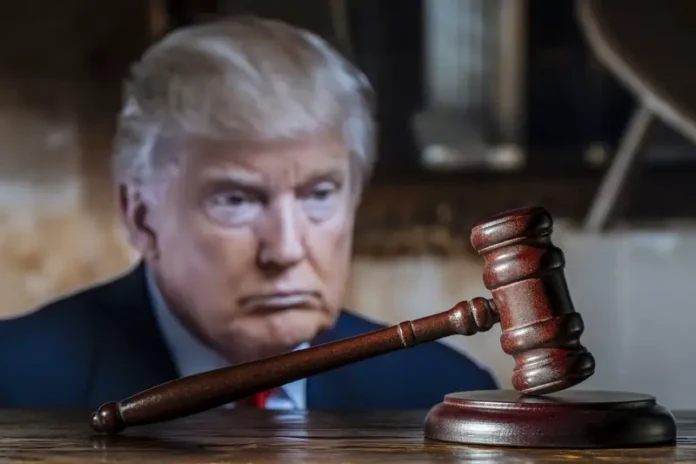
President Trump stunned a Rose Garden audience of police officers on May 11, 2026, when he openly credited his acting attorney general with keeping him out of prison — a remark critics immediately seized on as an admission that the nation’s top law enforcement officer functions as his personal defense lawyer.
Speaking at a National Police Week event, Trump heaped praise on Acting Attorney General Todd Blanche, the former personal attorney he elevated to run the Justice Department in April. “We have a man who’s doing a great job, I’ll tell you. I knew it, because he kept me out of jail for years,” Trump told the crowd, according to remarks captured on C-SPAN. “Acting Attorney General Todd Blanche. He kept me out of jail.”
From Defense Table to Justice Department
Blanche, a former Justice Department prosecutor, represented Trump as his personal attorney during the New York hush money trial. On May 30, 2024, a jury convicted Trump on 34 counts of falsifying business records tied to payments made to adult film actress Stormy Daniels regarding an alleged affair that Trump has denied. Despite the conviction, Trump received an unconditional discharge on Jan. 10, 2025 — days before his second inauguration on Jan. 20.
Trump nominated Blanche as deputy attorney general after returning to power, then elevated him to acting attorney general on April 2, 2026, following the firing of Pam Bondi. The trajectory — from defense table to running the department that once prosecuted his client — has alarmed legal observers who view it as a collapse of the traditional firewall between the White House and federal law enforcement.
The setting made Trump’s remarks especially striking. Standing before police officers gathered to honor fallen colleagues, the president pivoted from celebrating law enforcement to characterizing his prosecutions as politically motivated persecutions that Blanche helped him survive.
A Catalogue of Dismissed Cases
Beyond the New York conviction, Trump faced three additional indictments before returning to office. Federal prosecutors charged him with retaining classified documents and obstructing their retrieval. A separate federal indictment accused him of attempting to overturn the 2020 election. In Georgia, state prosecutors charged him with trying to overturn the results of that state’s election.
After Trump won the presidency a second time, the Department of Justice (DOJ) dropped its federal charges, citing the longstanding DOJ policy of not prosecuting sitting presidents. The state cases have languished.
“They would indict me left and right, the crooked Democrats,” Trump continued on May 11. “You know, it’s amazing. They impeach me. They indict me. Then, when I get in office, if I say something like, ‘Well, maybe that should be looked into.’ ‘Weaponization!'”
The president dismissed the prosecutions as “fake indictments” and insisted his administration has restored integrity to federal law enforcement, drawing a sharp line between the prosecutors who pursued him and the officials now in charge.
Critics See a Mob-Boss Tone
The reaction online was swift. Legal commentators noted that the president of the United States had publicly described the acting attorney general’s chief qualification as personal loyalty — not independence, not legal acumen, not allegiance to the Constitution. Detractors compared the praise to a mafia boss thanking his consigliere in front of a roomful of cops.
Blanche has not been a passive figure since assuming the role. The acting attorney general has presided over an indictment of former FBI Director James Comey, an escalating probe of former CIA Director John Brennan, and an investigation involving Anthony Fauci. Critics pointed to Blanche’s own 2023 defense of Trump, when he argued that “biased prosecutors pursued charges despite the evidence, rather than based on it” — language they now say describes the department he runs.
Since taking the helm at Justice, Blanche has moved to formalize that posture in concrete terms. On May 19, he appeared before a Senate Appropriations subcommittee to defend a newly created $1.776 billion “Anti-Weaponization Fund” — a taxpayer-funded program established without congressional approval to compensate individuals who claim they were unjustly investigated or prosecuted under the Biden administration. When pressed by senators, Blanche declined to rule out payments to Jan. 6 rioters who assaulted law enforcement officers — the same community Trump had addressed during the May 11 National Police Week event. Vice President JD Vance, also facing questions on the fund, said requests would be handled on a “case-by-case” basis and that “anybody can apply.”
Photographs from Sept. 5, 2024, show Blanche and fellow Trump defense attorney Emil Bove — who has since joined the Justice Department as a senior official — leaving the federal courthouse in Washington after a hearing in the election subversion case. By May 2026, Blanche occupied the office once held by the prosecutors who built that case.
Supporters of the president framed the May 11 remarks as candid recognition of an attorney who fought through what they consider politically driven charges. To them, Trump’s gratitude is no different from any client thanking a lawyer who delivered results.
But the venue, the audience, and the wording converged into something far more freighted. The man who runs the Justice Department was praised, in front of America’s police, for the years he spent helping the president evade its reach. Vice President Vance, seated among the administration officials honored at the event, offered no public comment on the remarks.
Trump closed the section of his speech with a coda that drew applause from the room. “Now we have law enforcement that loves our country,” he said, “not law enforcement that’s sick and dangerous.”