
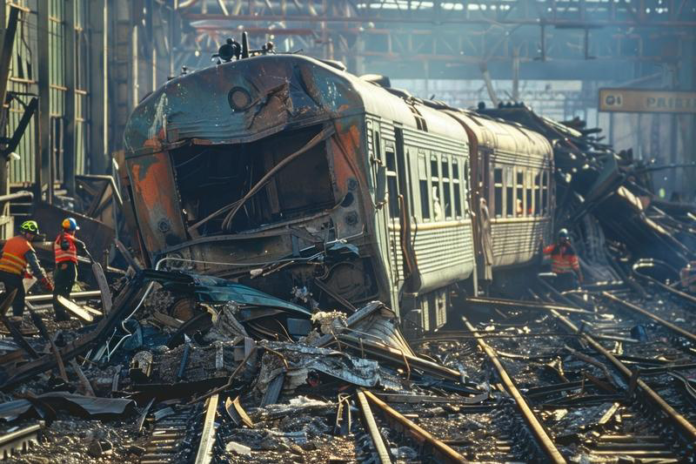
Provincial officials in Pakistan confirmed at least 47 deaths and 98 injuries from a suicide bombing that devastated a passenger train in Quetta, speaking to reporters on May 25, 2026, as rescue teams combed through charred debris and investigators worked to piece together the attack.
Families preparing to reunite for Eid al-Adha celebrations found themselves caught in the carnage when an explosive-laden car driven by a suicide bomber slammed into a shuttle train in the Faquir Abad area on the morning of May 24. The train, departing from Quetta’s army cantonment area, was transporting Pakistani security personnel and their families to connect with the Jaffar Express for journeys to their hometowns.
Explosion Causes Massive Destruction
Railways Minister Hanif Abbasi said the powerful explosion derailed the engine and three coaches while overturning two additional cars. Fire consumed two of the coaches, releasing thick black smoke that billowed over the city. Images from the scene showed overturned bogies (train undercarriages), burnt-out vehicles, twisted metal debris littering the tracks, and residential buildings suffering damage.
Aziz Khan, a resident of the area, told CBS News that crowds had assembled at the train crossing when the bomber attacked. He described how his house “jolted from the explosion,” accompanied by a “huge bang, very loud.”
“Many people (were) killed on the spot due to the intensity of the explosion,” Khan said, noting that gas cylinders in cars waiting near the tracks exploded as well, adding to the destruction. The neighborhood where the attack occurred typically houses security forces, and the blast severely damaged multiple nearby buildings and destroyed more than a dozen vehicles parked on the road.
Photographs captured paramilitary soldiers and volunteers extracting victims from the overturned coaches. Officials confirmed that 20 of the 47 killed were soldiers, with three Frontier Corps personnel and a family of four also among the dead. Doctors reported that 20 of the injured remained in critical condition. Hospitals throughout Quetta declared a medical emergency, and authorities opened an investigation that continues.
BLA Claims Responsibility
The outlawed Balochistan Liberation Army (BLA) claimed responsibility in a statement sent to reporters, describing the assault as a suicide bombing and saying it had targeted a train carrying security personnel. Independent verification of the claim was not possible. The BLA identified the bomber as 25-year-old Bilal Shahwani, a resident of Killi Sarde, and said he was a member of the group’s Majeed Brigade. Pakistani security forces subsequently raided Shahwani’s home and detained several of his relatives.
The BLA, which demands independence from Pakistan’s central government, has waged an insurgency for decades, arguing that local people are deprived of their due share of revenue from the province’s natural resources. Balochistan, which borders Iran and Afghanistan, is the country’s largest but least populated province and serves as a hub for the country’s ethnic Baloch minority. It is also home to major Chinese development projects and the deep-sea Gwadar port. The U.S. State Department has designated the BLA as a foreign terrorist organization. Islamic militants also operate within the province. Pakistani officials frequently allege the BLA receives backing from India — a charge New Delhi denies.
Leaders Condemn Attack
Prime Minister Shehbaz Sharif condemned the bombing on social media as a “cowardly act of terrorism.” Balochistan Chief Minister Sarfraz Bugti accused militants of targeting “innocent civilians, including women and children,” pledging to “hunt (them down).” Shahid Rind, provincial government spokesman, declared that terrorist elements “deserve no leniency.”
President Asif Ali Zardari said militants and their backers were seeking to undermine Pakistan’s role in regional and international peace efforts, promising that the country “will defeat terrorists, their facilitators, financiers and those providing them safe havens.”
A Pattern of Escalating Violence
The bombing was the latest in a string of strikes on trains, security forces, and infrastructure in the restive province. In March 2025, BLA militants hijacked the Jaffar Express while it carried army soldiers, taking hundreds hostage in a day-long standoff that ended with the deaths of 21 hostages, four troops, and all 33 attackers.
In early 2026, Pakistani forces said they killed 145 militants following coordinated attacks across the province that left nearly 50 people dead. In February 2026, coordinated suicide and gun attacks claimed by the group killed 18 civilians and 15 security personnel. A 2024 suicide bombing at a train station in the same region killed at least 26 people, including soldiers and railway staff.
For families who had boarded the shuttle to begin the Eid holiday, the journey ended in fire and twisted steel — another grim chapter in a province that has come to expect them.