
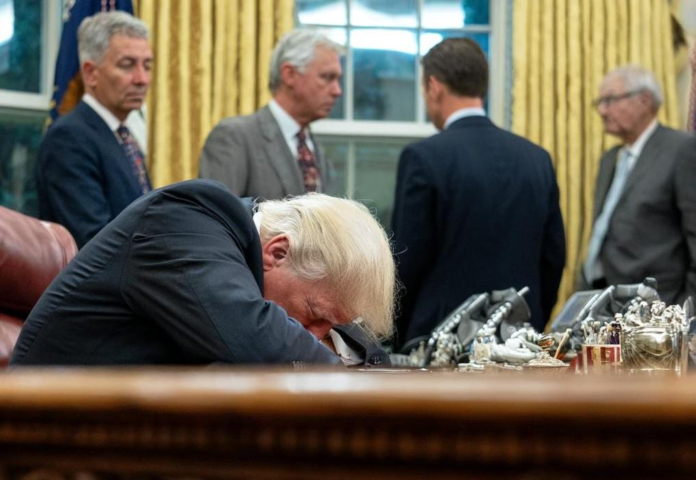
President Donald Trump’s niece is sounding a fresh alarm about her 80-year-old uncle’s condition, warning that jarring episodes at the G7 summit signal a decline that has become impossible to conceal.
Clinical psychologist Dr. Mary Trump, 61, offered the assessment in a conversation with journalist Steven Beschloss, 67, published in her newsletter on June 21, 2026. The exchange came after a bruising week at the G7 summit in Evian-les-Bains, France, during which observers pointed to repeated gaffes and erratic behavior as evidence that his cognitive and physical health have drastically diminished since his second term began on Jan. 20, 2025.
Diplomatic Chaos and Social Media Meltdowns
President Trump had stood alongside French President Emmanuel Macron inside the Palace of Versailles to sign a preliminary peace deal with Tehran, but the agreement unraveled almost immediately when Israeli forces pressed ahead with strikes on Lebanon. Iran responded on June 20, 2026, by closing the Strait of Hormuz, citing Israeli aggression against Iranian-backed Hezbollah militants. Trump then lashed out on social media, threatening Iran in a series of posts that observers described as a meltdown rather than a measured presidential response.
Among the moments that drew widespread attention, he announced his tardy entrance to a gathering of world leaders by proclaiming himself “the boss” — a declaration that drew mockery rather than the commanding authority it seemed intended to project.
Physical and Mental Warning Signs
The psychological assessments arrive alongside mounting concern about Trump’s physical presentation. Observers have noted bouts of visible confusion during public appearances, public sleeping fits, and a pattern of frantic late-night social media activity that has raised questions about his sleep and mental state. More recently, attention has turned to physical details including frequently black and blue hands, puffy cankles, and unexplained cuts that have prompted questions from critics and commentators alike.
When Beschloss asked Mary Trump whether her uncle appeared “unusually diminished,” Mary Trump said her uncle is in a downward spiral and that nothing frightens him more than humiliation. She argued that the president’s behavior is driven entirely by psychological need rather than policy goals, and that the convergence of his cognitive, emotional, physical, and psychological deterioration has reached a point where no amount of stage management can paper over it.
Mary Trump did not frame her uncle’s struggles as a moment of vulnerability deserving of sympathy. She noted pointedly that the humiliation he fears most is, in fact, self-inflicted, observing that nobody undermines Donald Trump more effectively than he undermines himself.
White House Fires Back
The White House pushed back forcefully on Mary Trump’s comments. White House Communications Director Steven Cheung, 43, dismissed her as a “stone-cold loser” with no credibility, and accused her of fabricating claims about the president purely to remain in the public eye. “Her entire worth as a human being is predicated on spewing lies about President Trump in a sad attempt to stay relevant,” Cheung said.
The White House’s sharp rebuttal is unlikely to quiet Mary Trump, who has made a career out of publicly scrutinizing her uncle’s fitness, character, and family history since his first term. Her latest broadside, delivered through her newsletter rather than a traditional media appearance, carries the weight of someone who believes the trajectory she has long described is now visible to anyone paying attention. The question of whether President Trump is up to the demands of the office shows no sign of fading from the national conversation.
U.S. and Iranian negotiators concluded a first round of high-level talks in Switzerland on June 22, agreeing to a road map for a final deal within 60 days and establishing a communication line to manage transit through the Strait of Hormuz. The situation grew more volatile in the days that followed, however, as Iran attacked U.S. military facilities in Bahrain and Kuwait on June 28 after American strikes on Iranian targets near the strait, and threatened to halt negotiations entirely. By late June 28, both sides agreed to stand down, with a new round of technical talks expected in Doha on June 30.