
Keith McAllister, 61, died after a catastrophic incident at a Long Island MRI facility when a 20-pound metal chain he wore for weight training became trapped in the machine’s magnetic field, yanking him violently into the equipment. His widow is seeking accountability through the courts.
The massive chain, which featured a large lock, pulled McAllister into the MRI scanner at Nassau Open MRI P.C. in Westbury on July 16, 2025. Emergency responders struggled for nearly an hour to free him from the machine. After being rushed to the hospital in critical condition, McAllister suffered multiple heart attacks and died the following afternoon, July 17, Nassau County police reported.
His widow, Adrienne Jones-McAllister, filed a wrongful death lawsuit on April 7, 2026, in state Supreme Court in Nassau County against multiple defendants including Nassau Open MRI P.C., East Coast Radiology P.C. (which contracted to use the facility’s MRI machine), Sun Enterprises (the LLC that leased the facility), and GM Partners Westbury LLC (the property owner).
The lawsuit claims facility staff committed a critical error by summoning McAllister into the MRI room to help his wife off the scanning table without instructing him to remove his metal necklace. The complaint alleges the technician failed to screen him properly, failed to shut down the machine before his entry, and failed to activate emergency procedures once he became trapped.
Jones-McAllister told News 12 Long Island that staff members at the facility already knew about her husband’s distinctive chain. “That was not the first time that guy has seen that chain,” Jones-McAllister said. “They had a conversation about it before.”
The widow witnessed the entire tragedy while still positioned on the scanning table inside the mobile MRI trailer attached to the building, where she was having images of her knee taken. She and the technician struggled for several minutes to free her husband before calling the police.
In a devastating account shared with local media, Jones-McAllister described the moment her husband was pulled into the machine. “He waved goodbye to me and his whole body went limp,” she said through tears.
Court documents detail the severe psychological impact on Jones-McAllister. The complaint states she “witnessed and was totally aware through all of her senses of the injuries and suffering and eventual death of her husband,” and alleges she has experienced “severe and serious personal, psychological and emotional injuries” resulting in “permanent effects of pain, disability, disfigurement and loss of body function.”
Attorney Andrew Finkelstein of Jacoby & Meyers and Ben Crump Law, PLLC, represents Jones-McAllister in the case. The lawsuit does not publicly disclose the amount of damages sought.
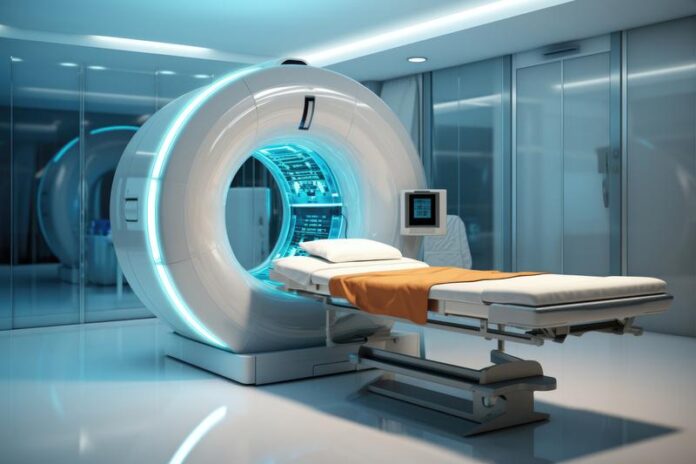
MRI machines generate extraordinarily powerful magnetic fields that can attract metal objects with devastating force. The National Institute of Biomedical Imaging and Bioengineering notes that these magnets can exert enough force “to fling a wheelchair across the room.” Metal items left on or near patients can be violently pulled toward the equipment at high speed, causing catastrophic injuries or death.
Screening patients and visitors for metal represents a fundamental and non-negotiable safety standard at medical facilities across the country. Because of these dangers, patients and anyone entering an MRI suite must remove all metal objects before approaching the scanning room.
McAllister, who lived on a fixed income from Social Security, is remembered by family as a devoted husband, father, grandfather, and friend. His stepdaughter, Samantha Bodden, set up a GoFundMe campaign to help cover burial costs, describing the financial challenges he faced.
Nassau Open MRI has declined to comment on the lawsuit or the circumstances surrounding the incident. The case now moves forward through Nassau County’s court system, where Jones-McAllister seeks accountability for what her attorneys have called “a preventable incident” that claimed her husband’s life and left her grappling with profound grief and psychological wounds the complaint describes as permanent.