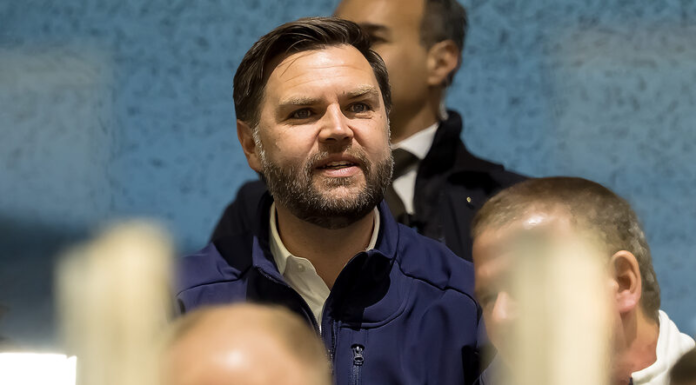
President Donald Trump publicly declared he would blame Vice President JD Vance if efforts to negotiate a deal with Iran fall apart, marking a stunning shift in how the administration is positioning its number two — moving from internal scapegoating over the Jeffrey Epstein scandal to public mockery over foreign policy.
“If it doesn’t work out, I’m blaming JD,” Trump said in remarks that quickly drew attention from late-night television and cable news hosts, who pointed out the president was openly admitting he planned to throw his vice president under the bus over Iran negotiations.
Comedian John Oliver covered the statement on his show, while MS NOW host Rachel Maddow’s program also noted that Vance was being sidelined despite his alleged skepticism about the war.
The Iran scapegoating comes just weeks after Trump’s longtime biographer Michael Wolff revealed that the White House had already begun sacrificing Vance behind the scenes — that time over the administration’s handling of the Epstein controversy.
Wolff: The Message Is Clear
Speaking on the latest episode of the Daily Beast’s “Inside Trump’s Head” podcast alongside co-host Joanna Coles, Wolff described Vance as having been cast aside following bombshell reporting that placed the vice president at the center of chaotic, behind-the-scenes efforts to manage fallout from Trump’s long-scrutinized ties to the disgraced convicted sex offender.
“More interesting, probably than what it says about Epstein, is JD Vance, who is really dumped … thrown in front of the bus here,” Wolff told co-host Joanna Coles on the podcast. He described the story as a carefully directed piece of messaging aimed squarely at one person.
“The White House is throwing JD Vance over the side,” Wolff said flatly. “That’s what’s going on here.”
Behind the Epstein Meltdown
Reporting drawn from the bestselling book “Regime Change: Inside the Imperial Presidency of Donald Trump” by Maggie Haberman and Jonathan Swan, published June 23, describes a White House in full damage-control mode after the Justice Department and FBI released a memo last July declaring there was no Epstein client list and that the financier died by suicide in federal custody.
According to the excerpt, top administration officials, including Vance and White House Chief of Staff Susie Wiles, gathered in the Situation Room on July 17, 2025 — without Trump — to debate how to contain the mounting outrage among MAGA voters who had been promised Epstein transparency and felt betrayed.
Vance, 41, took a notably aggressive posture inside those meetings, pushing colleagues to release the DOJ’s millions of Epstein files in full — even if some of the contents reflected poorly on Trump. He offered to personally go on television to defend the administration’s handling of the matter and floated the idea of enlisting Tucker Carlson to interview convicted sex trafficker Ghislaine Maxwell inside prison as a public relations gambit.
His colleagues largely dismissed his suggestions, choosing instead to close ranks around the president at all costs. The closed-door session was one of several emergency meetings convened as the administration scrambled to manage what Vance himself described to colleagues as a “huge problem.”
A Pattern of Vulnerability
For Wolff, a veteran journalist and author who has had extraordinary access to Trump throughout his political career, the report sends a signal directly back to Trump — that his vice president was not a loyal soldier during the crisis, but rather someone operating on a different set of priorities.
In Wolff’s telling, Trump’s position on Epstein has always been simple and unwavering: there is nothing to discuss, anyone raising the subject is an enemy, and any aide who treats it as a genuine problem is — by definition — not on his side. In that context, Vance’s push for transparency, his offers to go public, and his expressed belief that full disclosure was survivable all paint him as someone who fundamentally misread the president.
The vice president emerges from the account as a figure described in unflattering terms by the very colleagues who presumably leaked the story — depicted as panicked, out of step with Trump’s instincts, and convinced he understood the political moment better than the president whose loyalty he depended on.
The Epstein narrative is not the first time Wolff has flagged signs of tension between Trump and his vice president. On an earlier episode of “Inside Trump’s Head,” Wolff described tech billionaire Elon Musk’s high-profile demand during his public feud with Trump last summer — in which Musk called for Trump’s impeachment and urged that Vance take his place — as having planted a seed of lasting suspicion in the president’s mind.
Trump, Wolff suggested, has never been fully comfortable with Vance, viewing him as a choice driven in part by Musk’s financial leverage during the 2024 campaign rather than pure instinct.
What the Stakes Are for 2028
Analysis of the reporting shows senior officials were primarily concerned about losing support among core MAGA voters rather than political opposition — underscoring how internal fears about the base, not the broader electorate, shaped every decision the White House made during the crisis.
Vance’s instinct to get ahead of the story was, by that measure, a direct challenge to the president’s read of his own supporters. Vice President Vance has spent much of Trump’s second term positioning himself as the heir apparent within MAGA — attending rallies, managing congressional relationships, and carefully mirroring the president’s style and rhetoric.
A perception that he wavered during one of the administration’s most politically explosive moments, or worse, that he actively distanced himself from the president’s preferred approach, could prove deeply damaging as the 2028 succession fight quietly intensifies. That vulnerability has already been tested. Following the first round of formal U.S.-Iran negotiations in Switzerland on June 21 and 22, 2026, Vance declared that Tehran had agreed to invite International Atomic Energy Agency inspectors back into the country — calling it “a major milestone.” Iran’s Foreign Ministry denied the claim the following day, leaving Vance publicly contradicted on one of the deal’s most critical points and facing fresh questions about his command of the details he is now staking his political future on.
The Epstein episode adds another layer. Rather than loyalty during a crisis, the leaked account portrays Vance as someone who privately doubted the strategy, went his own way in internal debates, and misjudged what the president actually wanted — which, according to Wolff, was silence, not sunlight.
Wolff argues that wherever the leaks originated, the motive matters less than the effect: the story has been told, the frame has been set, and the damage to Vance’s standing with the one person whose opinion matters is already done.
White House Hits Back at Wolff
The White House did not engage with the substance of Wolff’s analysis. White House Communications Director Steven Cheung responded with a pointed personal attack, calling Wolff “a lying sack of ****” who had “been proven to be a fraud.”
The administration offered no denial of the Situation Room meetings or of Vance’s reported behavior inside them. Wolff, who rose to national prominence with his 2018 account of the early Trump White House, “Fire and Fury,” has faced persistent pushback from Trump allies over his sourcing and characterizations. He has nonetheless continued to produce reporting that the White House disputes but struggles to definitively disprove.
As Wolff put it on the podcast, in the Trump White House, everything is an audience-of-one performance — and by the time the excerpt hit newsstands, JD Vance’s reviews were already in.