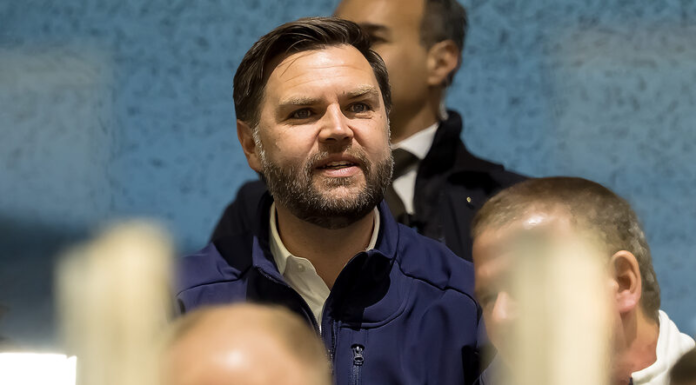
President Donald Trump has publicly stated he would blame Vice President JD Vance if his Iran deal fails, a move characterized as a “joke” that likely didn’t sit well with Vance’s office. The comment is part of what observers are calling a broader pattern of Trump regularly humiliating his number two on the world stage.
Vance has been tagged as the architect of Trump’s Iran deal and is being positioned to explain the administration’s decisions around the negotiations. The vice president all but soft-launched his presidential campaign, even as the White House appears to be setting him up as a scapegoat on multiple fronts. John Oliver recently covered Trump’s Iran deal negotiations, touching on the broader political dynamics surrounding Vance’s role in the talks.
The dynamic represents the latest chapter in mounting tension between the president and his vice president, with longtime Trump biographer Michael Wolff declaring that the administration is tossing Vance overboard to shield Trump from political damage. Wolff assessed the Daily Beast’s “Inside Trump’s Head” podcast alongside co-host Joanna Coles.
The Situation Room Showdown
The pattern became apparent following bombshell reporting from The New York Times about chaos inside the White House over the Jeffrey Epstein scandal. An excerpt from the forthcoming book “Regime Change: Inside the Imperial Presidency of Donald Trump” by Maggie Haberman and Jonathan Swan, published on June 23, revealed that Vance and White House Chief of Staff Susie Wiles gathered in the Situation Room on July 17, 2025, without Trump present, to contain mounting outrage among MAGA voters.
The emergency meeting followed a Justice Department and FBI memo released last July declaring there was no Epstein client list and that the disgraced, convicted sex offender died by suicide in federal custody. Top administration officials convened several closed-door sessions as Vance told colleagues the situation was a “huge problem.”
Inside those meetings, Vance adopted a combative stance, urging colleagues to release millions of Department of Justice (DOJ) files related to Epstein in their entirety, even if some contents reflected poorly on the president. He volunteered to personally appear on television to defend the administration and suggested enlisting Tucker Carlson to interview convicted sex trafficker Ghislaine Maxwell inside prison as a public relations move.
In another exchange detailed in the book, Vance argued the president “would be OK” with releasing specific sensitive documents implicating Trump, insisting it would earn the White House credit for transparency — only to be shut down by Chief of Staff Susie Wiles, who told him flatly that the president would not be fine with it. His colleagues rejected most of his proposals, opting instead to protect Trump at all costs.
A Calculated Leak
Wolff, a veteran journalist and author with extensive access to Trump throughout his political career, argued the Times report functions less as an Epstein story than as a deliberate strike against Vance. “More interesting, probably than what it says about Epstein, is JD Vance, who is really dumped … thrown in front of the bus here,” Wolff told co-host Coles on the podcast.
The leak sends a direct message back to Trump, Wolff maintained, signaling that his vice president failed to demonstrate loyalty during a crisis and instead pursued his own agenda. Trump’s position on Epstein has remained consistent and absolute, Wolff explained: the subject is off-limits, anyone who raises it is an adversary, and any aide treating it as a legitimate problem is working against him.
Vance’s push for transparency, his public relations offers, and his belief that full disclosure was politically manageable all demonstrate a fundamental misunderstanding of what the president wanted, according to Wolff’s analysis. “The White House is throwing JD Vance over the side,” Wolff said flatly. “That’s what’s going on here.”
The Times account portrays Vance through an unflattering lens provided by colleagues who presumably served as sources, depicting him as panicked, politically tone-deaf, and overconfident in his strategic instincts compared to Trump’s. Vance, 41, emerges from the reporting as someone who fundamentally misread the president.
Musk’s Shadow Looms Large
This is not the first instance of Wolff identifying friction between Trump and Vance. During a mid-June episode of the Daily Beast’s “Inside Trump’s Head” podcast, Wolff described Elon Musk’s high-profile demand last spring that Trump be impeached and replaced by Vance as having created lasting distrust in the president’s mind. Trump never fully embraced Vance, Wolff suggested, viewing his selection as partially driven by Musk’s financial influence during the 2024 campaign rather than genuine preference.
The Epstein crisis deepens that vulnerability. Instead of demonstrating unwavering loyalty, the leaked narrative shows Vance privately questioning the strategy, advocating for different tactics in internal debates, and failing to grasp what Trump actually desired: complete silence rather than any form of explanation.
White House Attacks Wolff Personally
The White House declined to address the substance of Wolff’s interpretation. White House Communications Director Steven Cheung launched a personal attack, calling Wolff “a lying sack of ****” who had “been proven to be a fraud.” The administration provided no denial of the Situation Room meetings or Vance’s conduct during them. Vance himself acknowledged the reporting contained “an element of truth,” while publicly raising alarm that Situation Room conversations may have been secretly recorded and handed to the book’s authors — an act he called “a felony.” Swan and Haberman declined to comment on whether audio recordings existed; Haberman noted that the only substantive White House response so far had amounted to confirming the accuracy of the reporting.
Wolff gained national prominence with his 2018 book “Fire and Fury,” chronicling the early Trump White House. Trump allies have consistently challenged his sourcing and characterizations, yet he continues producing reporting the White House disputes but cannot conclusively refute.
The 2028 Stakes
The implications extend far beyond one scandal. Vance has devoted much of Trump’s second term to positioning himself as the MAGA movement’s natural successor, attending rallies, cultivating congressional relationships, and carefully replicating the president’s style and messaging. Any perception that he faltered during a politically explosive moment, or actively separated himself from Trump’s preferred course, could severely undermine him as the 2028 succession battle quietly accelerates.
Senior officials worried primarily about alienating core MAGA voters rather than facing political opposition, illustrating how internal anxiety about the base shaped every White House decision during the crisis. Vance’s impulse toward proactive disclosure directly contradicted the president’s reading of his own supporters.
The origin of the leaks remains uncertain—whether from internal rivals seeking favor with Trump by sacrificing Vance, or from another faction entirely. Democrats have already moved to capitalize on the fallout: House Oversight Committee ranking member Rep. Robert Garcia (D-Calif.) announced plans to seek testimony from Vance, Wiles, and FBI Director Kash Patel over what he called the administration’s Epstein “cover-up.” Democrats lack subpoena power as the minority party, however, making compliance unlikely. Wolff’s argument centers not on motive but on outcome: the narrative has been established, the framework has been set, and Vance’s standing with the only person whose judgment matters has already been compromised.
As Wolff explained on the podcast, everything in the Trump White House functions as a performance for an audience of one—and by the time the Times excerpt reached publication, JD Vance’s performance review was already complete.