
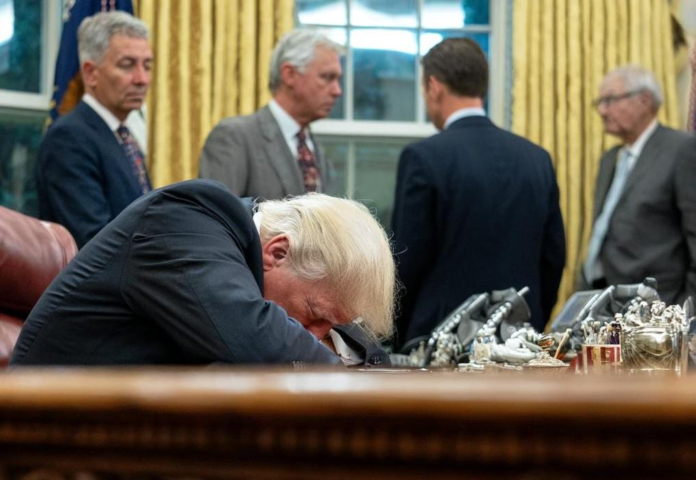
A cardiologist who once treated Vice President Dick Cheney has joined mounting concerns about the health of 80-year-old President Donald Trump, calling the commander-in-chief’s pattern of nodding off during daytime events “the most extraordinary thing” and suggesting it amounts to a serious medical problem never before observed in an American president. Dr. Jonathan Reiner, a professor at George Washington University, laid out his concerns in a New York Times essay and a CNN interview published two days ago.
Reiner also highlighted inconsistencies in explanations provided by White House medical staff. Trump’s physician attributed leg swelling to “chronic venous insufficiency,” yet no such swelling appeared in a physical examination conducted just months earlier, Reiner noted. That timing gap means the condition should be classified as acute, he argued, raising the possibility of heart or kidney disease instead.
The cardiologist revealed that Trump underwent MRI scans of his heart and abdomen in October, though the physician’s justification for ordering the imaging was limited to confirming “overall health.” Reiner also pointed out that 22 consultants evaluated the president during his latest physical, describing that count as “an extraordinary number of specialists.”
Reiner’s remarks come as another physician, Dr. Bruce Davidson—a board-certified internal medicine and pulmonary specialist at Washington State University’s Elson S. Floyd College of Medicine—argued publicly in January that video evidence suggests Trump experienced a stroke, likely on the left side of his brain and probably sometime in 2025.
Davidson, who has never examined the president in person, constructed his hypothesis from publicly released footage and disclosed medical information. He cited a shuffling walk, slurred speech that later cleared up, right-sided weakness and repeated instances of falling asleep during the day. He also noted Trump takes 325 mg of aspirin daily, a dosage typically prescribed to ward off a second stroke rather than as initial prevention. Davidson detailed his reasoning on “The Court of History” and “The Daily Beast Podcast,” along with an opinion article.
White House officials have categorically dismissed the stroke allegation, and no physician with direct access to Trump has validated any such episode.
Governor Needles President Over Energy Levels
Criticism of Trump’s stamina escalated after a brief Los Angeles stop on Tuesday, August 4, when California Gov. Gavin Newsom—a longtime Democratic foe—seized on a short tarmac exchange to mock the president’s demeanor. In an X post the next morning, Wednesday, August 5, Newsom’s press office attached a 14-second video clip and labeled the visit “a total snoozer,” complaining of “Very low energy. No speech. He could barely take a question on the tarmac.”
The footage captured Trump stepping cautiously away from journalists as one asked about Rep. Max Miller, the embattled MAGA lawmaker from Ohio facing pressure to resign over allegations from his ex-spouse of domestic violence and child abuse. Hearing Miller’s name, the president turned briefly, shrugged, expressed hope Miller would remain and resolve the matter, then departed.
Trump’s western swing took him to a Republican National Committee fundraiser at his Rancho Palos Verdes golf club before continuing to Nevada, where he spoke at the Red Rock Casino, Resort & Spa to promote the administration’s tax relief plans.
Armed Intruder and Aviation Protocol Breach
Security incidents overshadowed the journey. In the days before the president reached the Southern California course, police arrested an armed individual spotted on foot at the Rancho Palos Verdes property carrying a magazine loaded with 16 rounds and extra ammunition, the Los Angeles County Sheriff’s Department reported.
Separately, Marine One lifted off from the White House on Tuesday, August 4, while commercial aircraft continued operating at a nearby airport, a departure from standard safety procedures. The White House and the Federal Aviation Administration (FAA) both stated the president faced no danger.
Persistent Questions and a Fierce Rebuttal
Doubts surrounding the president’s physical state have surfaced repeatedly. Trump has drawn attention for chronically bruised hands, swollen ankles, public episodes of drowsiness and sporadic mental lapses. White House officials have uniformly maintained he is in good health and responded to Newsom’s latest attack with a blistering counterassault.
White House spokesperson Davis Ingle called the governor the worst and possibly the dumbest chief executive in the nation, insisting Trump’s sharpness, vitality and openness contrast sharply with the prior administration. Ingle charged that Democrats concealed former President Joe Biden’s mental and physical deterioration while now attacking Trump.
Davidson’s stroke theory remains unconfirmed by anyone who has personally treated the president. As a long-distance diagnosis built on video snippets and a single disclosed prescription, the assessment carries inherent constraints, and no member of Trump’s medical staff has endorsed it. Nevertheless, the pairing of a physician’s stroke hypothesis and a governor’s viral jab has thrust the president’s fitness back into the center of political debate.
The dueling accounts stand in direct conflict. One narrative depicts a leader diminished by age and potential illness; the other presents an energetic executive whose detractors, according to the administration, are recycling tactics once deployed to shield a Democratic predecessor. Undisputed is that the health of the oldest sitting president in the nation’s history has become an unavoidable thread running through his second term—one that a low-key tarmac moment and an unverified medical theory have only magnified.